
Solar Power Backup Solution for Communication Base Stations
1. Solution Overview
For off‑grid communication base stations located in remote mountainous areas, open‑river channels, border zones and forest regions, common challenges include high grid‑laying costs, frequent power outages leading to network disconnection, high operation‑and‑maintenance costs for diesel generators, as well as noise pollution.
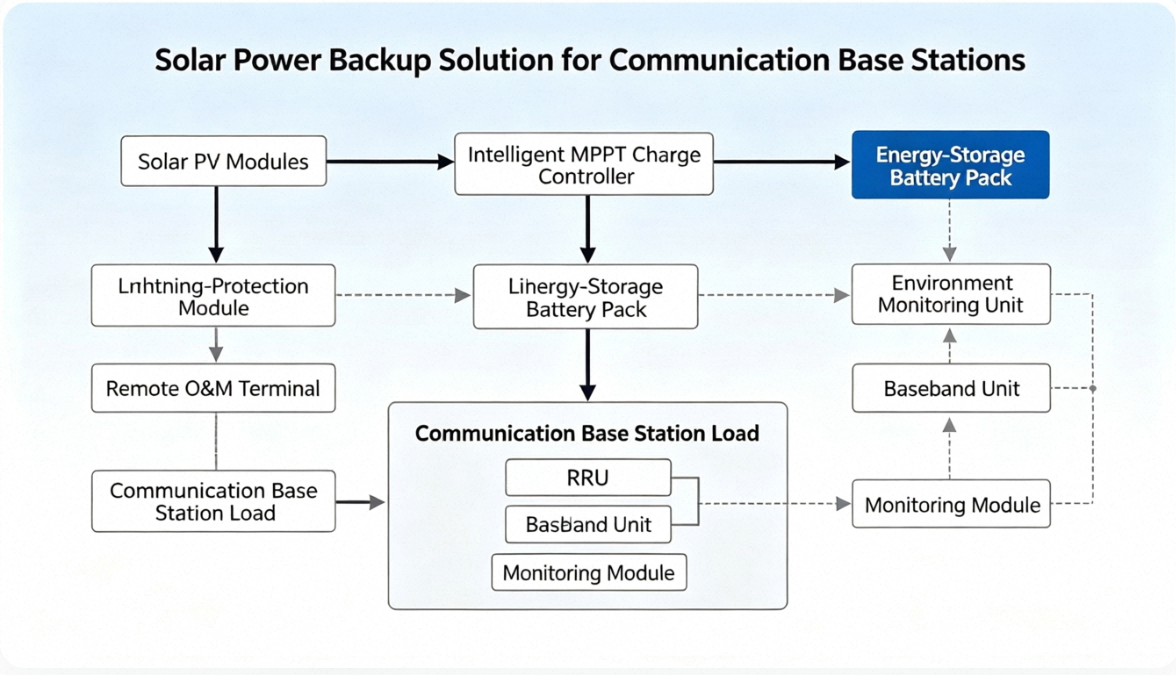
The off‑grid solar backup power system for communication base stations adopts clean photovoltaic energy, paired with lithium‑ion storage batteries / gel batteries and intelligent charge‑discharge controllers, to build an independent off‑grid power supply system. It delivers 7×24‑hour continuous power for 5G/4G base stations, IoT communication towers and remote radio units (RRU). It features zero‑cable‑laying requirements, low‑level maintenance and long‑term stable power supply.
Applicable sites: field micro base stations, forest‑fire‑prevention communication towers, water‑conservancy monitoring communication stations, expressway‑side base stations, and island communication stations.
2. System Topology
3. Core System Components
| Function & Description |
|---|
| High‑efficiency monocrystalline solar panels, customizable for 12V/24V/48V; ETFE flexible type / aluminum‑alloy‑framed fixed type optional. High‑low‑temperature resistance, hail resistance, IP65 outdoor protection. |
| Maximum‑power‑point‑tracking charging with conversion efficiency ≥98%; integrated protection against over‑charging, over‑discharging, short‑circuit, reverse connection and lightning stroke; supports 4G remote data upload. |
| Two optional solutions: 1) Gel lead‑acid battery: low‑cost, adaptable to low‑temperature field environments; 2) Lithium‑iron‑phosphate battery: cycle life ≥3000 times, compact size, service life of 8‑12 years. |
| DC secondary lightning arrester, integrated outdoor power distribution box to simplify on‑site wiring. |
| Real‑time monitoring of power generation, battery voltage, load power consumption and equipment fault alarms; cloud‑based remote management. |
4. Measured Performance Data
| Parameter Index |
|---|
| 96%‑98.5% |
| ‑30℃ ~ +65℃ |
| 3‑7 days (battery capacity expandable on demand) |
| ≥25 years |
| ≥3000 cycles (80% DOD) |
| 5‑8 years |
| IP65 |
| 12V / 24V / 48V DC |
Annual O&M Cost Comparison: The solar‑powered solution requires one‑time capital investment with almost zero fuel expenditure; annual maintenance cost is less than USD 110. For diesel generators, the combined annual cost of fuel and routine maintenance for a single site ranges from USD 1100‑1900. The solar solution achieves full payback of total equipment investment within 3‑5 years.
Note: Currency conversion is for reference only; original Chinese RMB‑denominated cost logic is retained.
5. Core Solution Advantages
Independent off‑grid power supply without power‑grid construction: Direct installation for remote sites without municipal power access. Eliminates cable‑laying and transformer infrastructure, greatly cutting pre‑construction investment.
Lower long‑term comprehensive cost: One‑time installation harnesses free solar energy. No continuous fuel procurement required; full payback of total equipment investment within 3‑5 years.
All‑weather stable endurance: PV power and battery capacity are configured according to local solar‑irradiation statistics. Energy‑storage batteries guarantee continuous power supply during rainy weather to prevent base‑station power‑off and network outage.
Intelligent remote O&M support: Real‑time cloud upload of voltage, battery state‑of‑charge and power‑generation data. Active fault alarm push, eliminating frequent mountain‑site inspection trips for field staff.
Superb outdoor environmental adaptability: Wide‑temperature design; resistant to heavy rain, salt spray and sand dust. Reliable operation in alpine mountain areas and high‑humidity island environments.
Green, low‑carbon and zero‑emission: Power supplied by clean energy with no exhaust gas or noise, complying with low‑carbon construction requirements for the communications industry.
6. Typical Configuration Schemes (3 Standardized Options for Customer Selection)
| Scheme 1|Micro Remote Base Station | Scheme 3|High‑power Backbone Communication Base Station |
|---|---|
| 150W 24V monocrystalline module | 1000W 48V PV array |
| 20A MPPT | 60A MPPT |
| 24V 100Ah LiFePO₄ battery | 48V 500Ah lithium‑battery system |
| Small‑size IoT communication tower, micro signal‑filling base station | Backbone communication base station (mains‑power switching module optional) |
| ≤60W | 180W‑400W |
7. Application Scenarios
- Forest‑fire‑prevention mountain communication base stations
- River‑and‑reservoir water‑conservancy monitoring communication towers
- Expressway‑side signal base stations
- Island and coastal‑border communication sites
- Grassland and forest‑region IoT communication equipment
- Oil‑and‑gas‑pipeline remote‑communication equipment
8. FAQ
Q: Will the base station lose power on rainy days?
A: Battery capacity is configured according to local average rainy‑day statistics for each project. The standard configuration delivers 3‑7‑day self‑sustaining energy storage. Larger‑capacity batteries can be deployed for regions with long‑lasting rainy seasons.
Q: Can custom‑power solutions be provided?
A: Yes. We offer one‑on‑one matching of PV panel power and battery capacity based on actual base‑station power consumption and local sunshine duration. OEM of complete power‑supply systems is supported.
Q: Can the equipment operate in cold winter conditions?
A: Low‑temperature‑resistant battery versions are available. A low‑temperature heating module can be added to the system to ensure stable operation at ‑30℃ in alpine‑cold regions.