
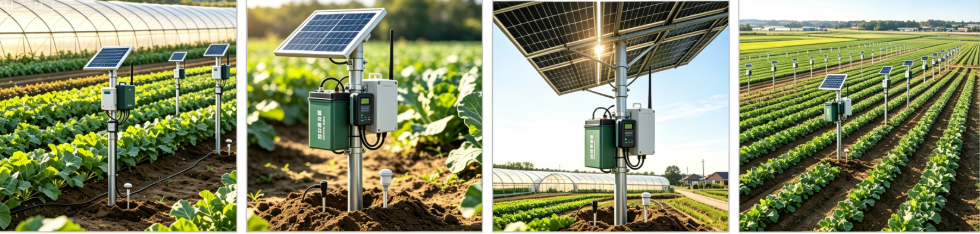
Smart agriculture is one of the most active fields for IoT technology deployment. From soil moisture monitoring and smart irrigation control to field weather stations, pest forecasting lights, aquaculture water quality monitoring, and livestock tracking, these devices all face the same core challenge: Who will supply the power?
The lack of municipal grid power in deep farmlands, unstable solar harvesting, and frequent battery replacements have long restricted the large-scale deployment of smart agriculture. This comprehensive guide explores how off-grid solar solutions can seamlessly address these challenges.
1. Unique Power Supply Challenges in Agriculture
Agricultural projects differ significantly from urban engineering projects due to strict constraints:
- Highly Dispersed Installation Points: A single 100-acre farm may require 10–20 independent monitoring points, each needing its own power supply.
- Extreme Cost Sensitivity: Agricultural projects typically operate on thin margins, making budget constraints a primary concern.
- Harsh Operating Conditions: Equipment must withstand extreme heat (up to 50°C inside greenhouses), high humidity (>90% in irrigation zones), pesticide corrosion (especially in sulfur fumigation environments), and rodent/insect damage to cables.
- Difficult Maintenance: During busy farming seasons, there is little time for battery replacements, and muddy roads often prevent vehicle access to remote field sites.
- High Standby Requirements: Many sensors require uninterrupted year-round operation; power failures can lead to critical data loss.
These factors demand a power solution that is affordable, highly reliable, and virtually maintenance-free. Many IoT startups have failed in this sector simply by underestimating these power supply difficulties.
2. The Optimal Power Solution for Agriculture: Split Solar Systems
To meet these unique agricultural needs, we recommend a split solar power system. In this setup, solar panels are mounted independently on brackets or existing structures (like fences or greenhouse frames), while the battery and control box are buried underground or placed in waterproof enclosures. Burying the battery effectively protects it from extreme heat and human/animal interference.
Core Advantages:
- ETFE/PET Encapsulated Panels: Lightweight and weather-resistant, covering power needs from 0.5W micro-sensors to 80W irrigation valves.
- LiFePO4 Batteries: Superior low-temperature performance and a lifespan of 5–8 years (2000+ cycles), vastly outperforming traditional lead-acid batteries.
- MPPT Controllers: Deliver 20–30% higher charging efficiency than PWM, excelling in cloudy or weak winter light conditions.
- IoT Remote Monitoring: Check device status, charging current, and battery levels via smartphone anywhere, with automatic anomaly alerts.
- Modular Design: Farmers can install the system using a manual without professional electricians. Hot-swappable battery modules make maintenance effortless.
3. Standard Configurations for Typical Agricultural Scenarios
Power consumption varies drastically across different agricultural applications. Based on extensive field experience, we have summarized the following standard configurations:
| Application Scenario | Typical Load & Characteristics | Recommended Configuration | Est. System Cost (USD) |
|---|---|---|---|
| Soil Moisture Monitoring | 0.1–0.5W (Reports every 30 mins) | 5W Solar Panel + 12Ah LiFePO4 Battery | ~$55 |
| Field Weather Station | 3–8W (Wind, Temp, Humidity, Rain) | 20W Solar Panel + 20Ah LiFePO4 Battery | $110 – $165 |
| Smart Irrigation Valves | High surge current (1–2A for 30-60s) | 30W Solar Panel + 40Ah LiFePO4 Battery | $165 – $250 |
| Pest Forecasting Lights | 50–100W (Nighttime operation only) | 60–100W Solar Panel + 60–100Ah Battery | $345 – $550 |
| 4G Video Surveillance | 15–40W (High IR power at night) | 100W ETFE Panel + 60Ah LiFePO4 Battery | $275 – $480 |
| Aquaculture Monitoring | 2–5W (Dissolved O₂, pH, Temp, 24/7) | 10W Solar Panel + 20Ah LiFePO4 Battery | ~$80 |
4. Investment Return Analysis (ROI)
Taking a smart irrigation system as an example, a solar power system requires an initial investment of roughly $275 to $700. Compared to trenching for municipal grid power (which costs at least $1,400 to $2,800), the solar solution saves over 60% in upfront costs.
Additionally, it eliminates manual inspection costs (saving $275–$700 annually) and incurs zero energy fees. Over a 5-year period, the ROI exceeds 300%. When factoring in smart agriculture subsidies (often 30–50% in many provinces), the system can pay for itself within the first year. Furthermore, precision irrigation can reduce water usage by 30–50%, save electricity by 20–30%, and increase crop yields by 10–20%, delivering massive comprehensive economic benefits.
Shanghai Geningtech manufactures everything from solar panels to complete power systems in-house, providing the most reliable and cost-effective off-grid solutions for smart agriculture.
5. Real-World Customer Validation
Xinjiang Cotton Farm: A large-scale 3,000-acre cotton base deployed 120 sets of soil moisture monitoring and smart irrigation systems powered by our solar solutions. After two full growing seasons, the system achieved a 99.3% availability rate. The client reported a 35% reduction in water usage and a 15% increase in cotton yield, achieving full ROI within the first year.
Shouguang Vegetable Greenhouses (Shandong): 50 greenhouses were equipped with temperature, humidity, and CO₂ monitoring systems powered by our 5W micro-solar panels. At just ~$55 per greenhouse, farmers can now monitor crop conditions directly from their smartphones, significantly improving cultivation management.
6. Common Selection Pitfalls to Avoid
Through our work with agricultural clients, we have identified several common mistakes in system selection:
| Common Misconception | The Reality & Best Practice |
|---|---|
| “Bigger solar panels are always better.” | Oversized panels paired with small batteries can lead to overcharging and battery damage. Best Practice: Configure panel wattage at 1.2 to 1.5 times the load power. |
| “Lead-acid batteries are cheaper and more practical.” | While the upfront cost is lower, lead-acid batteries require replacement every 2 years, resulting in higher long-term costs and environmental pollution. Best Practice: Always opt for LiFePO4 for longevity and eco-friendliness. |
| “MPPT and PWM controllers are basically the same.” | Field tests show MPPT generates 25–35% more power daily than PWM. Best Practice: The higher initial cost of MPPT pays for itself within a few months through increased efficiency. |
Avoiding these pitfalls ensures your smart agriculture project runs smoothly from day one. Contact Shanghai Geningtech today to customize your perfect off-grid power solution!