
When we scan a QR code to unlock a shared bike or hop on an e-scooter, few of us stop to consider a seemingly minor yet crucial question: how do they get their power? In today’s era of IoT and green mobility, powering these devices has evolved far beyond the simple “plug in when dead” routine. It has developed into a highly automated, intelligent “green micro-infrastructure.” From the micro-solar generation of smart locks to the “charge-as-you-shine” capability of solar e-bikes, and the smart battery-swapping networks for shared e-scooters, these technologies not only solve the “last-mile” problem but are also quietly reshaping the urban energy micro-cycle.
The “Micro-Light” Magic of Smart Locks: From Mechanical to IoT
Early shared bikes relied on pure mechanical locks that required no power. However, with the rise of IoT, smart locks became essential for precise positioning, remote unlocking, and billing. This introduced a new challenge: how to power these scattered devices without frequent manual charging?
The answer lies in self-powering systems.
Modern smart locks are essentially highly integrated micro-IoT terminals. They house low-power NB-IoT (Narrowband IoT) communication modules, dual-mode GPS/BeiDou positioning chips, and various sensors. To sustain these modules long-term, locks employ several self-powering technologies:
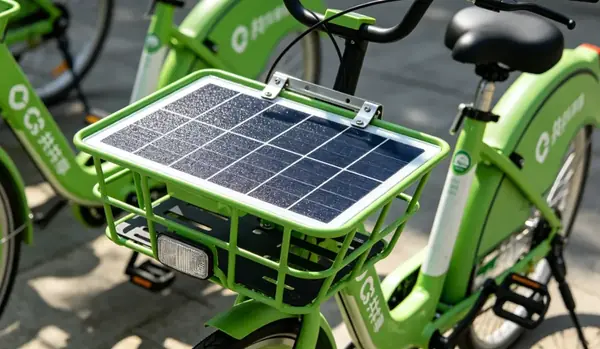
Solar Power: This is the most prevalent solution. A small monocrystalline solar panel is integrated into the top of the basket or the lock’s casing. Though small, it generates enough daily power in sunny weather to cover the lock’s consumption, including Bluetooth communication, GPS reporting, and the motor for unlocking. Even on cloudy days, a built-in lithium battery can sustain operation for several days.
Kinetic Generation: Some models use a dynamo hub. As the user pedals, the wheel’s rotation drives a micro-generator inside the hub, converting mechanical energy into electricity to charge the lock’s battery in real-time. This “charge-as-you-ride” approach ensures that the more the bike is used, the more power it generates.
Dual-Mode Positioning & Low-Power Communication: Communication between the lock and the server relies primarily on NB-IoT technology. This technology is characterized by wide coverage and extremely low power consumption, allowing a single small lithium battery to power the lock for 2-3 years. Meanwhile, the connection between the lock and the user’s phone is handled via Bluetooth, a process that doesn’t require the phone to have a cellular signal, greatly enhancing user experience.
This “self-generation and self-consumption” system has completely freed shared bikes from the need for manual charging, enabling true unattended operation and autonomous energy replenishment.
Solar E-Bikes: From “Range Anxiety” to “Charge-as-You-Shine”
If the smart lock on a shared bike represents “micro-light” generation, the solar e-bikes emerging in recent years have pushed the utilization of solar energy to a new level. Brands like “Tuneng” are completely disrupting the traditional model of e-bikes that depend on charging piles.
These vehicles integrate highly efficient mobile solar power systems into their frames. Through smart algorithms and energy chips, they achieve “charge-as-you-shine” and “charge-while-riding.” Real-world tests in cities like Xuzhou show that on a sunny day, they can add up to 20 kilometers of range, and even on cloudy days, they can add about 10 kilometers. For commuters with a daily travel distance of 5-10 kilometers, this means they can say goodbye to charging piles entirely. Just park the bike in the sun, and it will be fully charged when you get home.
This decentralized charging method offers multiple advantages:
Safety: It uses 48V low-voltage balanced automatic charging technology, avoiding the risks of battery overcharging and spontaneous combustion associated with traditional 220V high-voltage fast charging.
Convenience: No need to search for charging stations; the bike charges as long as it’s parked in the sun, and excess energy is automatically stored.
Eco-Friendliness: It achieves true zero-carbon emissions, making every kilometer ridden a direct use of green energy.
Currently, these solar e-bikes are on the market in over 30 countries and regions, including France, Japan, and Spain, and are planned for large-scale promotion domestically, signaling a new “zero-carbon” era for personal short-distance travel.
The “Backend Brain” of Shared E-Bikes: Smart Dispatch and Battery-Swapping Networks
Unlike shared bikes that require no manual charging, shared e-bikes (e-scooters) have higher power demands and larger batteries, making their energy management more complex. They generally adopt a “vehicle-battery separation” model, backed by an intelligent battery-swapping network fully managed by a platform’s “backend brain.”
Smart Dispatch: Every shared e-bike has a built-in Battery Management System (BMS) that reports real-time battery data to the cloud. When a vehicle’s battery level drops below a set threshold (e.g., 15%), the system automatically flags it as “ready for swap” and generates a dispatch task.
Operational Swapping: Based on tasks assigned by the system, operations personnel travel to specific locations with fully charged batteries. They simply open the bike’s smart battery compartment, remove the depleted battery, and insert the full one—a process that takes only a minute or two.
Centralized Charging: The depleted batteries are then transported to city-level centralized charging stations. Here, they undergo professional constant-current-constant-voltage charging in a temperature-controlled environment, ensuring battery lifespan and safety.
Additionally, some shared bike systems are starting to introduce solar charging stations at their docking points. For example, some shared bike projects in North America have deployed solar charging stations, which not only reduce the carbon emissions from operations vehicles making frequent battery-swap trips but also solve the problem of grid access at certain stations.
The “Capillaries” of Urban Energy: Integrated Solar-Storage-Charging
Beyond these models, a more forward-looking “solar-storage-charging” integrated station is beginning to emerge in cities. This type of station integrates photovoltaic power generation, energy storage systems, and charging facilities. The roof of the parking canopy is made of solar panels, which generate electricity during the day and store it in a small energy storage system. At night, it can provide charging services for e-bikes.
The advantages of this model are:
Energy Self-Sufficiency: It reduces reliance on the urban power grid, achieving truly green charging.
Peak Shaving and Valley Filling: The energy storage system can balance the difference between daytime generation and nighttime demand, enabling 24/7 uninterrupted power supply.
Flexible Deployment: Its modular design allows for flexible deployment in communities, office buildings, roadsides, or anywhere with available space.
From the micro-light generation of smart locks to the “charge-as-you-shine” capability of solar e-bikes, and from the smart battery-swapping networks for shared e-scooters to the integrated solar-storage-charging stations, these technologies together form a vast and sophisticated “green micro-infrastructure” network. Like the “capillaries” of a city, they deliver clean energy to every corner of mobility, solving pain points like charging difficulties and range anxiety, while invisibly driving urban transportation toward a low-carbon, intelligent, and convenient future. As technology continues to advance, this network will become even smarter and more efficient, bringing more surprises to our urban travel.