
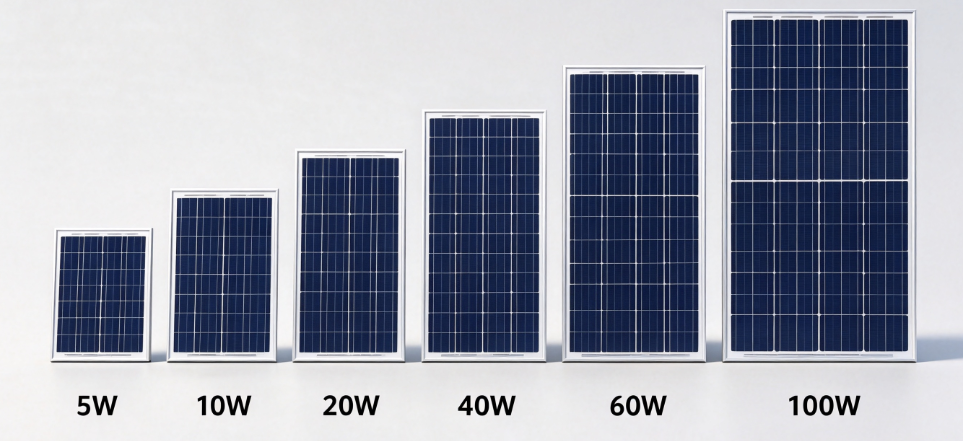
Custom solar panels are not off-the-shelf products. Unlike standard modules, parameters like wattage, dimensions, and output voltage must be precisely matched to your specific project requirements. Many clients new to customization often feel overwhelmed by where to start. As a direct manufacturer, we help customers solve these selection challenges daily.
This guide outlines a complete, step-by-step process for selecting the right custom solar solution for your needs.
1. Determine the Power Output (Wattage) First ⚡
The first step is calculating the required power based on your load consumption and local sunlight conditions. Use this fundamental formula:
Solar Panel Wattage = Daily Energy Consumption (Wh) ÷ Peak Sun Hours (h) ÷ System Efficiency Coefficient (~0.75)
For example, if a monitoring device consumes 240Wh per day and your location receives 4 hours of effective sunlight, the calculation would be:
240 ÷ 4 ÷ 0.75 = 80W
Note: This formula provides a baseline estimate. In practice, it is recommended to add a 10-20% safety margin to account for cloudy days and battery charging losses. If your equipment operates primarily at night, you must also factor in battery storage efficiency.
2. Define the Dimensions Based on Efficiency 📏
Once the wattage is determined, the physical size depends on the encapsulation technology and available installation space. High-efficiency technologies like ETFE and Back Contact (BC) cells offer conversion rates of 18-22%, resulting in a smaller footprint for the same power output. Conversely, PET and epoxy resin panels typically have lower efficiency (14-16%) and require larger surface areas.
Example: For a 50W requirement, an ETFE panel might measure approximately 350×540mm, whereas a PET panel would need roughly 420×560mm.
Recommendation: If space is limited (e.g., on top of a surveillance pole or narrow eaves), choose high-efficiency ETFE or BC solutions. If space is not a constraint, standard PET solutions offer better cost-performance.
3. Match the Voltage Correctly 🔋
The output voltage of the solar panel must align with your charge controller and battery system. Incorrect voltage selection can severely impact charging efficiency or even damage equipment.
For most IoT scenarios, we recommend pairing an 18V panel with an MPPT controller for the best overall performance.
4. Consider Environmental Factors 🌧️
The operating environment dictates the durability requirements of the panel:
Harsh Outdoors (Forests, Mountains, Marine): Choose ETFE or Glass encapsulation. These materials offer superior weather resistance and a lifespan of 8-15 years.
Indoor or Semi-Outdoor (Greenhouses, Buildings): PET or Epoxy Resin are cost-effective choices with a sufficient lifespan of 3-5 years.
Special Environments: For high-salt spray areas (seaside) or chemical plants, we recommend ETFE panels paired with anti-corrosion connectors.
5. Select Interfaces and Mounting Methods 🔧
Do not overlook the details of cabling and installation, as they directly affect user experience.
Connectors: Common options include MC4 connectors, aviation plugs, DC terminals, and USB outputs.
Mounting: Options range from screw fixation (most common) and adhesive backing (for lightweight, low-power panels) to slot mounting and custom brackets.
Quick Reference Tables for Custom Solar Selection
To make your decision-making process faster and more accurate, we have summarized the key selection criteria into two quick-reference tables:
Table 1: Common Voltage Matching Guide
| Solar Panel Voltage | Battery System | Charge Controller | Best Application |
|---|---|---|---|
| 6V | 3.2V LiFePO4 | PWM / Basic | Low-power sensors, micro IoT |
| 12V | 12V Lead-Acid / Li-ion | PWM / MPPT | General purpose, standard IoT |
| 18V | 12V System | MPPT (Recommended) | Optimal efficiency for IoT |
| 24V / 36V | 24V System | MPPT | High-power (>50W) base stations |
Table 2: Encapsulation Material & Environment Match
| Encapsulation Type | Efficiency | Lifespan | Ideal Environment |
|---|---|---|---|
| ETFE / Glass | High (18-22%) | 8 – 15 Years | Forests, mountains, marine, harsh weather |
| PET / Epoxy | Standard (14-16%) | 3 – 5 Years | Indoor, greenhouses, semi-outdoor |
| BC (Back Contact) | Highest | 10+ Years | Premium aesthetics, space-limited areas |
Partner with Shanghai Geningtech for Custom Solutions 🏭
At Shanghai Geningtech, we support full-series customization ranging from 0.1W to 180W. We can tailor dimensions, voltage, cable lengths, and backsheet colors to meet your exact project specifications. We also provide sample prototyping services to help accelerate your project deployment.