
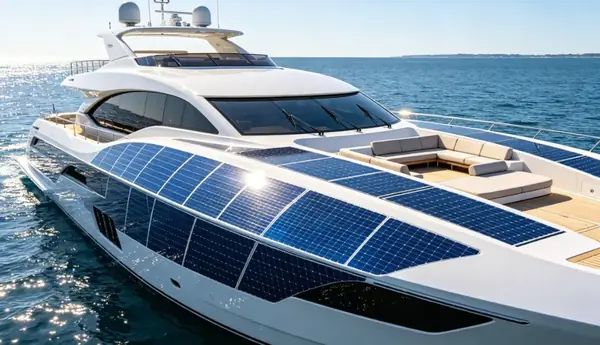
When a yacht leaves the bustling marina and sails into the vast blue ocean, it brings not only the free breeze but also a rigorous test for independent energy. In the marine environment, electricity is not just about comfort; it is the lifeline for navigation safety and communication. Traditional rigid glass solar panels are bulky and fragile on a bouncing deck, while ordinary flexible panels struggle to withstand the relentless erosion of high-salinity seawater. Today, flexible solar modules equipped with an ETFE (Ethylene Tetrafluoroethylene) coating are becoming the ideal energy solution for ships, yachts, and coastal facilities with their outstanding weather resistance and lightweight design, providing a continuous supply of green power for every voyage.
Facing the Harsh Trials of the Ocean: Why ETFE is the Ultimate Choice
The marine environment is a severe test for any equipment, especially the omnipresent salt mist. Salt mist is not only highly corrosive but also attaches to the surface of equipment with the sea breeze, gradually destroying ordinary encapsulation materials.
Many low-cost flexible solar panels on the market use PET (Polyethylene Terephthalate) as the surface coating. Under long-term UV exposure and salt mist erosion, this material is highly prone to yellowing, embrittlement, and even cracking, leading to damage to the internal solar cells. ETFE, as a fluoropolymer, possesses extremely excellent chemical inertness and anti-aging properties. It can effectively resist salt mist corrosion and maintain high light transmittance under intense UV radiation, ensuring that the modules maintain high power generation efficiency even in harsh marine environments. Furthermore, the ETFE surface has extremely low surface energy, presenting a hydrophobic self-cleaning characteristic similar to the “lotus effect.” Seawater and dust are difficult to adhere to, and they can be washed away by rain or waves, greatly reducing maintenance costs.
The Perfect Combination of Lightweight and Flexibility: Reducing the Burden on the Deck
For ships and yachts, every extra kilogram of weight directly affects speed and fuel efficiency. Traditional glass modules are not only heavy but also pose a risk of shattering when the boat rocks violently, and flying glass shards are a huge safety hazard.
ETFE flexible modules completely solve this pain point. Their weight is only a fraction of that of glass modules of the same area, greatly reducing the load-bearing burden on the deck. At the same time, their excellent flexibility allows them to perfectly fit the curved awnings of yachts, canvas sunshades, or various irregular curved surfaces of the hull. This “tailor-made” installation method not only maximizes the available power generation area but also avoids the risk of water leakage caused by drilling holes in the hull, truly achieving a unity of non-destructive installation and efficient power generation.
From Coastal Waters to the Open Ocean: All-Scenario Energy Empowerment
The application of ETFE flexible modules goes far beyond the deck of a yacht; it is providing reliable power support for a wider range of marine and coastal scenarios.
The “Silent Companion” for Yachts and Sailboats: While sailing or at anchor, ETFE modules can provide continuous power for onboard lighting, navigation systems, refrigeration equipment, and even air conditioning, completely eliminating the noise and exhaust fumes from generators, allowing the sailing experience to return to tranquility and nature.
The “Off-Grid Guardian” for Coastal Facilities: In coastal lighthouses, navigational buoys, or remote coastal observation stations, laying traditional cables is costly and difficult to maintain. With their superior salt-mist resistance and wave resistance, ETFE modules have become the most stable power source for these off-grid facilities, ensuring 24/7 uninterrupted operation of critical equipment.
The “Green Replenishment” for Offshore Platforms: For offshore drilling platforms or research vessels, ETFE modules can serve as an auxiliary power supply system, effectively reducing the load on the main generator, cutting carbon emissions, and assisting marine engineering towards a greener and more environmentally friendly direction.
Smart Integration: Building a Safe Marine Power System
When using solar power on ships, safety is always the top priority. ETFE modules are usually used in conjunction with highly efficient MPPT (Maximum Power Point Tracking) controllers, which can track the maximum power point of the solar panels in real time, ensuring maximum charging efficiency even in cloudy conditions or when the light angle changes.
In addition, given the particularity of the marine environment, the entire power supply system also needs to have comprehensive reverse connection, short circuit, and overcharge protection. High-quality marine ETFE modules are also meticulously designed in terms of junction boxes and connectors, usually adopting high-grade waterproof sealing designs to ensure that electrical connections remain safe and reliable in humid, salt-mist-filled environments, eliminating the risk of leakage and short circuits.
From coastal leisure yachts to deep-sea research vessels, ETFE flexible solar modules are redefining the way marine energy is harvested with their unique advantages of being “light, flexible, tough, and strong.” It is not just a power generation panel, but a green link connecting human exploration and harmonious coexistence with nature. In the future, with the continuous advancement of technology, we have every reason to believe that every ship sailing into the deep blue will possess a “green heart” that never runs dry.