
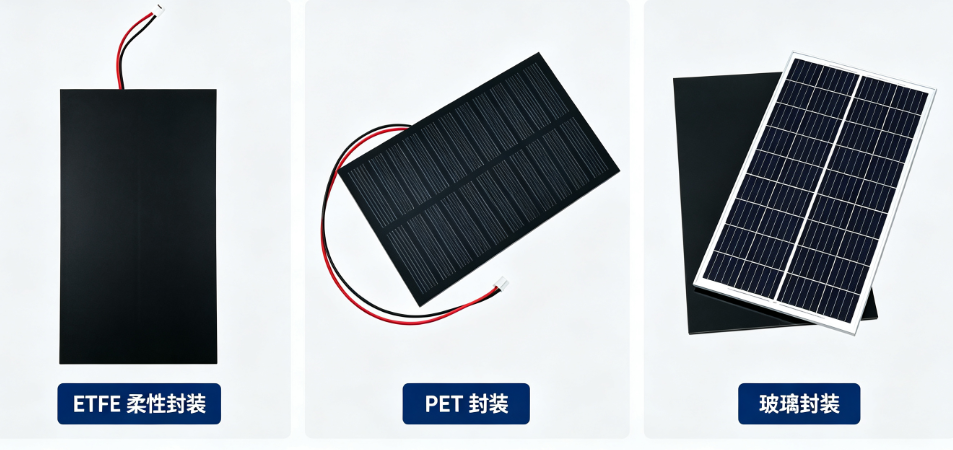
In the rapidly expanding sectors of IoT monitoring, smart agriculture, forest fire prevention, and remote off-grid power supply, custom solar panels serve as the critical core component for continuous terminal power. The choice of encapsulation material directly dictates the panel’s weight, flexibility, lifespan, weather resistance, and overall cost.
Currently, there are three mainstream encapsulation solutions on the market: ETFE flexible solar panels, PET (epoxy resin) solar panels, and tempered glass laminated panels. This comprehensive guide compares these three options based on physical appearance, performance parameters, and application scenarios to help you make the optimal choice for your project.
1. Appearance & Structural Characteristics
PET Epoxy Resin Solar Panels
PET encapsulation, commonly known as epoxy resin drip-glue panels, is the most cost-effective solution for small-scale PV applications. The surface is coated with epoxy resin over a PET backsheet, making the panel lightweight and slightly bendable.
Pros: Extremely low entry price, simple manufacturing process, and fast production turnaround. Ideal for indoor use, short-term trials, and sample development.
Cons: Significant durability issues outdoors. Prolonged UV exposure causes the epoxy to yellow, crack, and allow moisture ingress. The typical outdoor lifespan is only 1 to 3 years.
ETFE Flexible Solar Panels
ETFE flexible modules utilize a fluoroplastic ETFE film as the top layer over a flexible substrate. This allows the panel to conform to curved surfaces seamlessly without rigid frames.
Pros: Excellent UV resistance and anti-aging properties far superior to PET. High light transmittance and extreme flexibility make them perfect for RVs, portable devices, and curved equipment.
Cons: Higher material cost than PET. The soft film is vulnerable to scratches from sharp objects, making it unsuitable for harsh environments with flying gravel or severe sandstorms.
Tempered Glass Laminated Solar Panels
Utilizing high-transmittance tempered glass, EVA film, and a backsheet in a full lamination process with an aluminum alloy frame, this is the industry-standard rigid PV module.
Pros: The double-sealed structure offers unmatched hardness, impact resistance, scratch protection, and maximum waterproof/dustproof performance. It is the premier choice for remote base stations, forest fire monitoring, and long-term unattended IoT sites.
Cons: Completely rigid (cannot be bent) and significantly heavier due to the glass and aluminum frame, requiring robust mounting structures.
2. Core Parameter Comparison
| Comparison Item | PET Epoxy Resin | ETFE Flexible | Tempered Glass |
|---|---|---|---|
| Surface Material | Epoxy Resin | ETFE Fluoroplastic Film | High-Transmittance Tempered Glass |
| Flexibility | Slightly Bendable | Moderately Flexible | Completely Rigid |
| Outdoor Lifespan | 1–3 Years | 5–8 Years | 10–15 Years |
| UV Resistance | Poor (Prone to Yellowing) | Excellent (Anti-Aging) | Extreme |
| Impact & Scratch | Poor (Easily Scratched) | Moderate (Vulnerable to Sharp Objects) | Excellent (Sand & Gravel Resistant) |
| Waterproof Rating | Basic | IP65 | IP67 |
| Weight | Lightest | Medium | Heaviest |
| Cost | Lowest | Medium-High | Highest |
| Best Application | Indoor / Samples | Portable / Curved Surfaces | Long-Term Unattended Outdoor |
3. In-Depth Pros & Cons Analysis
PET Epoxy Resin PV Panels
Advantages: Unbeatable price advantage for low-power samples; ultra-thin and lightweight for easy flat-surface installation; short production cycle for fast custom delivery.
Disadvantages: Weak weather resistance. Long-term sun and rain exposure causes yellowing and continuous efficiency decay. Extreme temperature fluctuations can crack the glue layer, allowing moisture to corrode the cells. Unsuitable for extreme cold, high humidity, or salt-spray environments.
Recommendation: Strictly for indoor use, short-term project testing, or single-use devices. Not recommended for long-term unattended outdoor projects.
ETFE Flexible PV Modules
Advantages: Flexible enough to fit curved housings, offering versatile installation. The chemically stable ETFE film resists UV and aging far better than drip-glue panels. Frameless design ensures lightweight transport and installation.
Disadvantages: Lacks hard surface protection; sand and gravel can cause permanent scratches that reduce light transmittance. Continuous severe bending can cause micro-cracks in the internal cell grid lines. Costs rise significantly for high-power flexible panels.
Recommendation: Ideal for portable devices, RVs, marine vessels, and curved-surface monitoring. Note: For windy/sandy outdoor projects, an additional protective cover is advised.
Tempered Glass Laminated PV Modules
Advantages: Unmatched overall durability. Tempered glass completely blocks moisture and UV rays. High mechanical strength withstands hail and gravel impacts. Offers the slowest power degradation over years, making it perfect for multi-year continuous off-grid IoT systems.
Disadvantages: Rigid structure cannot adapt to curved installations. Heavy weight demands sturdy poles and brackets. Highest procurement cost among the three.
Recommendation: The ultimate choice for smart agriculture sensors, remote communication base stations, forest fire monitoring, and river hydrology stations.
4. Practical Selection Guide for Off-Grid IoT Projects
Today, countless remote monitoring devices rely on solar + lithium battery off-grid systems. Once installed, these devices often go years without frequent maintenance. Therefore, the encapsulation choice directly determines the entire power system’s lifespan.
| Application Scenario | Recommended Solution | Reasoning |
|---|---|---|
| Short-term projects, prototyping, indoor use | PET Epoxy Resin | Controls upfront costs; high weather resistance isn’t required indoors. |
| Portable devices, yachts, mobile/curved carriers | ETFE Flexible | Conforms to curves, lightweight, and highly durable. |
| Long-term unattended remote stations (Agri/Fire/Water/Base) | Tempered Glass Laminated | Longest lifespan, highest reliability, and virtually maintenance-free. |
⚠️ Critical Warning: Many projects opt for cheap PET panels to save money upfront, only to face massive system failures within 1–2 years. The total replacement cost far exceeds the initial savings. Never compromise on material selection for long-term outdoor deployments.
Beyond encapsulation, always verify the cell type (N-type high-efficiency cells yield more power), operating voltage, and terminal specifications. Pairing your panel with an MPPT controller and LiFePO4 battery will maximize power generation and build a rock-solid off-grid system.
5. Conclusion
There is no absolute “best” PV encapsulation. The optimal choice depends on four key factors: installation environment, expected lifespan, spatial constraints, and budget.
PET is for low-cost, short-term use.
ETFE is for installation flexibility and portability.
Tempered Glass is for long-term outdoor reliability.
During project bidding and system design, clearly specify the encapsulation type to avoid future failures caused by material misunderstandings. Matching the right encapsulation effectively reduces failure rates, minimizes OPEX (operational expenses), and ensures uninterrupted operation for your sensors and monitoring terminals.