
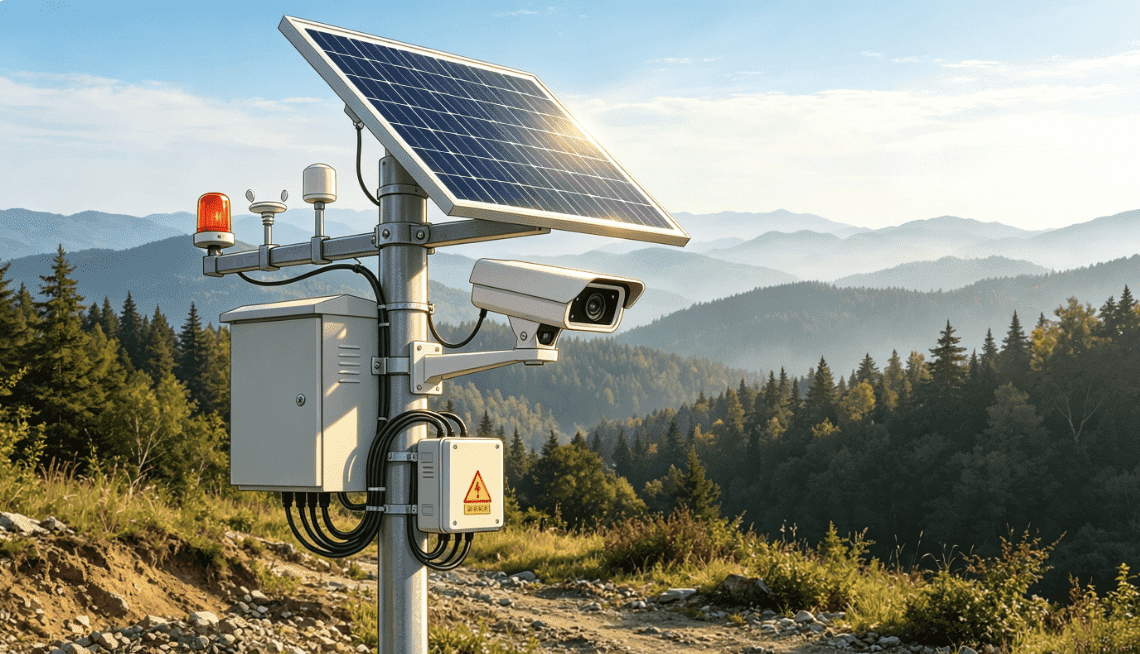
Forest fire monitoring is a top priority in modern forestry management. With over 200 million hectares of forest covering 22% of China’s landmass, tens of thousands of fire monitoring stations are scattered across remote, mountainous regions. However, the vast majority of these sites lack municipal grid power and are difficult to access. This is precisely where solar-powered IoT systems prove their immense value. In recent years, China’s National Forestry and Grassland Administration has vigorously promoted “Smart Forest Fire” initiatives, demanding comprehensive fire risk monitoring in key forest areas. Yet, reliable power supply remains the biggest bottleneck to achieving this goal.
1. Power Supply Pain Points in Forest Fire Monitoring
A typical forest fire monitoring station consists of dual-spectrum infrared thermal imaging cameras (15-60W, with higher peak power during PTZ control), weather sensors (5-10W for wind, temperature, humidity, and pressure), and data collection/transmission terminals (5-15W for 4G/5G or BeiDou communication). The total power draw is approximately 30-80W, requiring 24/7 continuous operation. Reliability is paramount—a power failure during fire season can lead to catastrophic consequences.
Traditional solutions face insurmountable challenges:
- Grid Connection Costs: Trenching and cabling in mountainous terrain cost between $1,400 and $7,000 per kilometer.
- Diesel Generators: High operational costs, with fuel and labor easily exceeding $1,400 annually, plus the need for dedicated personnel for regular inspections.
- Lead-Acid Batteries: Short lifespan (1-2 years). In deep mountains, the labor cost to replace a single battery often exceeds the cost of the battery itself.
A real-world case in Northeast China highlights this danger: a monitoring station completely failed during fire season due to lead-acid battery winter degradation. Fortunately, no fire occurred that year, but the potential consequences were severe.
2. The Solar IoT Power Solution
To solve these pain points, we recommend the following standardized configuration:
- 100-300W ETFE Solar Panels: Exceptional weather resistance, anti-UV aging, and a lifespan of 8-10 years, perfect for high-UV forest environments.
- 60-200Ah LiFePO4 Batteries: Over 2,000 charge cycles (5-8 times longer than lead-acid) and weighing only one-third as much.
- MPPT Charge Controllers: Maximum Power Point Tracking boosts charging efficiency by 20-35% compared to PWM, ensuring effective charging even on cloudy days.
- IoT Remote Management Module: Dual 4G/NB-IoT communication for real-time reporting of battery voltage, charging current, load power, and device health.
Core System Components Overview
| Component | Specification | Key Advantage | Typical Range |
|---|---|---|---|
| ETFE Solar Panel | ETFE encapsulation, 100-300W | 8-10 year lifespan, anti-UV | 100W / 200W / 300W |
| LiFePO4 Battery | 60-200Ah, 2000+ cycles | 5-8x longer than lead-acid | 60Ah / 100Ah / 200Ah |
| MPPT Controller | MPPT algorithm, 30-60A | 20-35% higher efficiency vs PWM | 30A / 40A / 60A |
| IoT Module | 4G/NB-IoT dual-mode | Real-time monitoring & alerts | 4G / NB-IoT / BeiDou |
Smart Remote Management Features:
- Automatic alerts for low battery, equipment failure, unauthorized access, or tilt/vibration.
- Remote parameter configuration and firmware updates, eliminating the need for physical tower climbs.
- Historical data storage and curve analysis to assist in maintenance decisions.
With our IoT management platform, a single maintenance worker can efficiently manage hundreds of monitoring stations.
3. Field Deployment Experience in Forest Regions
Shanghai Geningtech has supplied over 300 solar power systems for provincial forestry projects. We have distilled several critical field deployment insights:
- Shading Assessment: Winter sun angles are low, and surrounding trees can drastically reduce effective sunlight. Use solar simulation software beforehand and add a 10-20% power margin if necessary.
- Wildlife Protection: Squirrels and birds frequently chew cables. All exposed cables must be protected with metal braided sleeves or anti-rodent corrugated tubing. Controller and battery enclosures should be at least IP65 rated.
- Extreme Cold Resilience: Northeastern winters can drop to -40°C. We recommend LiFePO4 battery packs with built-in heating elements that automatically activate below 0°C to ensure safe charging.
- Lightning Protection: Open, elevated forest areas are highly susceptible to lightning. Surge protection devices (SPDs) and reliable grounding (resistance <10Ω) are mandatory.
- Anti-Theft Measures: Equip enclosures with vibration alarms and GPS tracking modules to deter theft in remote areas.
5-Point Field Deployment Checklist
| Check Item | Recommendation | Why It Matters |
|---|---|---|
| Shading Assessment | Simulate winter sun angles; add 10-20% power margin | Tree shadows can cut effective sunlight by 40-60% |
| Cable Protection | Use metal braided sleeves or anti-rodent tubing | Squirrels and birds chew exposed cables daily |
| Cold-Weather Battery | Install self-heating LiFePO4 packs; auto-activate below 0°C | Temperatures below -20°C can permanently damage standard batteries |
| Lightning Protection | Install SPDs; ground resistance <10Ω | Open forest ridges are prime lightning targets |
| Anti-Theft | Add vibration alarms + GPS tracking modules | Remote equipment theft is a recurring problem |
Client feedback shows that our systems operate fault-free for over 3 years, reducing maintenance frequency from monthly to quarterly and cutting OPEX by over 70%. For areas with poor cellular coverage, we also offer BeiDou satellite short-message backup channels to ensure zero data loss.
4. Selection Advice & Cost Analysis
For forest environments, ETFE encapsulation is strongly recommended. Although the unit price is roughly double that of PET, the 8-10 year lifespan makes it significantly cheaper over the system’s lifecycle. Battery capacity should be designed for 5-7 consecutive cloudy days (7 days for southern forests; 5 days for northern forests). All enclosures must be IP65+ with waterproof and anti-corrosion connectors.
Traditional vs. Solar: 5-Year Cost Comparison
| Cost Category | Traditional Grid + UPS | Solar IoT System | Savings |
|---|---|---|---|
| Grid Connection / Setup | $4,000 – $11,000 | $110 (pole mounting) | Save ~$4,890 upfront |
| Equipment | ~$420 (UPS unit) | ~$420 (Solar + LiFePO4 + IoT) | Comparable |
| Battery Replacement (5 yrs) | ~$420 (lead-acid x2) | $0 (2000+ cycle LiFePO4) | ~$420 saved |
| Annual Electricity | ~$21/year | $0 (100% renewable) | ~$105 saved over 5 years |
| Annual Maintenance | ~$70-$140 | ~$28 (remote IoT monitoring) | ~80% OPEX reduction |
| Deployment Time | 2-3 months | 1-2 days | Massive time saving |
| 5-Year Total Cost (TCO) | ~$6,435 | ~$670 | ~$5,765 saved |
For a typical 30W monitoring device, a complete solar system (panels, battery, controller, enclosure, and mounting brackets) costs between $500 and $800. Compared to grid connection ($4,000-$11,000+ for cabling, plus ongoing electricity and maintenance), the solar solution saves over 80% in total lifecycle costs. Furthermore, deployment takes only 1-2 days, whereas grid connection can take 2-3 months.
Shanghai Geningtech provides end-to-end services from system design to manufacturing, ensuring your forest fire monitoring equipment never loses power in the deep mountains.
5. After-Sales Service & Guarantee
We stand behind our products with comprehensive support:
- Warranty: 3-year system warranty (10 years for solar panels, 5 years for battery packs).
- Response Time: Technical issues addressed within 24 hours nationwide; replacement units provided within 72 hours for critical failures.
- Proactive Maintenance: Quarterly inspection services to identify and resolve hidden risks before fire season.
- On-Site Support: For large-scale projects, we dispatch technicians for installation, commissioning, and team training.
Service & Warranty Coverage
| Service Item | Coverage Detail | Response Time |
|---|---|---|
| System Warranty | Full system coverage | 3 years |
| Solar Panel Warranty | Power output guarantee | 10 years |
| Battery Pack Warranty | Capacity retention guarantee | 5 years |
| Technical Support | Nationwide remote assistance | Within 24 hours |
| Critical Failure Replacement | Backup unit dispatch | Within 72 hours |
| Preventive Maintenance | Quarterly inspection visits | 4 times per year |
| On-Site Engineering | Installation & training support | Project-dependent |
6. Conclusion: Empowering Smart Forestry with Reliable Energy
Ultimately, the transition to solar-powered IoT systems is not just a cost-saving measure—it is a critical upgrade in national forest safety. By replacing fragile traditional power methods with resilient, self-sustaining solar energy, forestry departments can achieve true 24/7 situational awareness in the most inaccessible terrains. The combination of durable ETFE panels, long-lasting LiFePO4 batteries, and intelligent remote management transforms isolated monitoring points into a cohesive, smart defense network.
At Shanghai Geningtech, we are committed to providing the robust power infrastructure that modern forestry demands. With our proven hardware, field-tested deployment strategies, and dedicated after-sales support, we ensure that your critical monitoring equipment remains the unblinking eye of the forest—always powered, always vigilant, and always ready to protect our green heritage.