
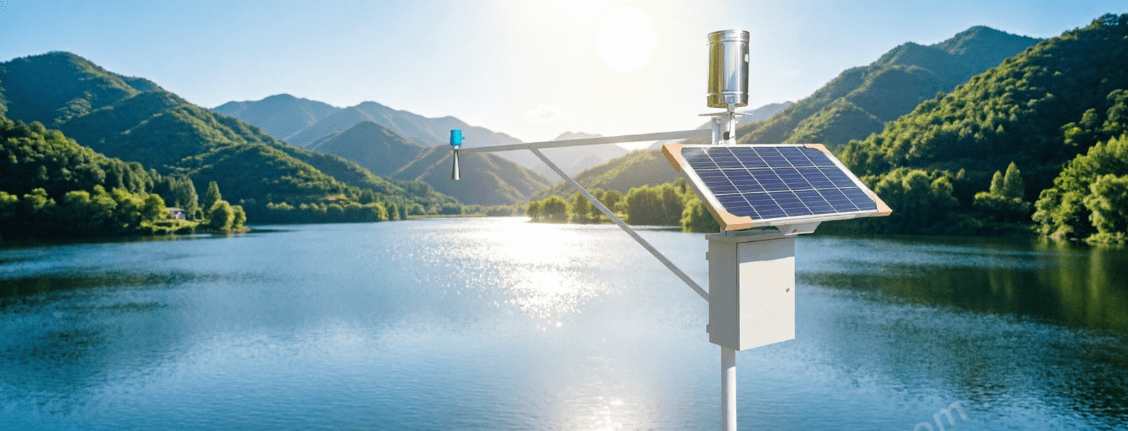
Hydrological and water conservancy monitoring serves as the foundational data source for flood prevention, drought relief, water resource management, and river/lake ecological protection. China is home to over 100,000 hydrological monitoring stations distributed across remote areas along rivers, lakes, and reservoirs. From glacier meltwater monitoring stations on the Qinghai-Tibet Plateau to flood warning stations in the middle and lower reaches of the Yangtze River, and from groundwater monitoring in the arid Northwest to tidal stations along the coast, every station faces the same core challenge: Who will supply the power?
Located in remote areas with difficult access and challenging maintenance conditions, these stations require a highly reliable power source. The solar-powered IoT supply system is precisely the optimal solution for this scenario.
1. Power Supply Requirements for Hydrological Stations
A typical hydrological monitoring station is equipped with the following devices:
- Water Level Meters / Flow Meters: 5~15W (power consumption varies between ultrasonic and radar types).
- Rainfall Sensors: Extremely low standby power (tipping-bucket or weighing types).
- RTU Data Collection Terminals: 3~8W (the core unit for data acquisition and processing).
- Video Surveillance Cameras (Optional): 15~30W (used for remote inspection and real-time flood viewing).
- BeiDou / 4G Communication Modules: 5~10W (for data reporting and remote control).
The total comprehensive power draw generally ranges between 20W and 60W, requiring stable 24/7 operation. The highest operational intensity occurs during the flood season (June to September), which unfortunately coincides with the highest frequency of rainy days and the lowest solar irradiance. This places extremely high demands on the system’s energy storage design.
Critical Reliability Requirements:
- Zero Data Interruption: Especially during the flood season, any interruption in water level data can pose severe safety risks.
- Waterproof & Moisture-Proof: Riverbanks often maintain 80~100% relative humidity year-round, making condensation a major concern.
- Lightning Protection: Open water areas have a significantly higher probability of lightning strikes compared to urban environments.
- Anti-Theft & Anti-Vandalism: Remote, unattended stations are at high risk of theft.
2. Why Choose Solar IoT Power Systems?
Traditional power solutions face numerous challenges. Grid connection is extremely difficult; most stations are far from residential areas, making cable trenching cost between $1,400 and $4,200 per kilometer. A 10km distance could cost $14,000 to $42,000. Lead-acid batteries only last 1~2 years, creating a heavy maintenance burden. Transporting and replacing a single battery at a remote station accessible only by a mountain road can cost $280 to $700 in labor and transport alone. Furthermore, lacking remote monitoring means personnel must drive hundreds of kilometers for routine inspections, resulting in extremely low efficiency.
Solar IoT power systems perfectly resolve all these pain points:
- Rapid Deployment: No cable laying required; installation is completed in one day, plug-and-play.
- Ultra-Long Endurance: LiFePO4 batteries combined with large-capacity designs ensure 7~10 days of continuous operation during overcast weather.
- Smart Remote Monitoring: 4G/NB-IoT modules report voltage, current, battery level, and temperature in real-time, triggering automatic alerts and dispatching maintenance orders upon anomalies.
- Professional Lightning Protection: Built-in three-stage surge protection and reliable grounding of solar panel brackets, passing national lightning protection certification.
3. Special Design Considerations for Hydrological Stations
Designing for hydrological stations is far more complex than standard outdoor setups. Special factors must be thoroughly considered:
High Humidity Environment: Extreme relative humidity on riverbanks requires condensation sensors and automatic dehumidification solutions (e.g., breather valves + heating/dehumidification modules) inside the enclosure. All electronic components must be coated with conformal coating (three-proof paint).
Water Level Fluctuations: River levels can surge by several meters. Solar panels and battery enclosures must be installed at least 1 meter above the historical maximum flood level to prevent submersion during flood seasons.
Lightning Protection: Most hydrological stations are located in open valleys with frequent lightning activity. A three-stage lightning protection architecture (power surge protection + signal surge protection + grounding grid) is mandatory, with grounding resistance strictly maintained below 4Ω.
Low-Temperature Operation: Winter temperatures at northern hydrological stations can drop to -30°C. LiFePO4 batteries must be equipped with low-temperature heating functions to ensure normal charging and discharging at -20°C.
Data Protocol Compatibility: The hydrological industry has strict communication protocol requirements (e.g., SL651-2014 Hydrological Monitoring Data Transmission Protocol). Our RTUs and controllers fully support integration with provincial hydrological platforms.
Key Selection Recommendations:
- Solar Panels: Choose ETFE or glass encapsulation for salt spray and high-humidity resistance.
- Battery Capacity: Design for 10+ days of continuous overcast weather (as required by water conservancy industry standards).
- Controllers: Select MPPT controllers with RS485/Modbus communication interfaces for seamless RTU integration.
- Communication Modules: Support MQTT protocol for compatibility with mainstream IoT platforms.
- Mounting Brackets: Hot-dip galvanized treatment is essential to prevent rapid rust and corrosion in high-humidity riverside environments.
4. Real-World Success Case
In 2024, a provincial hydrological bureau deployed our power systems across 60 newly built monitoring stations. The project covered diverse data collection needs, including water level, rainfall, and video. Based on varying power consumptions, stations were configured with 100~200W solar panels and 60~150Ah LiFePO4 battery modules.
After a full year of operation—including the severe flood season—the system achieved an availability rate exceeding 99.5%, reducing OPEX by 70% compared to grid-tied solutions. Notably, during the 2024 flood season, multiple stations endured 10 consecutive days of heavy rain. The systems operated flawlessly, and water level data reporting was never interrupted, earning high recognition from the provincial bureau.
5. Why Choose Shanghai Geningtech?
Shanghai Geningtech has accumulated extensive project experience in the hydrological sector, with products certified by the Water Conservancy Ministry’s Hydrological Instrument Quality Supervision and Inspection Center.
We provide more than just power supply equipment; we offer a full lifecycle service encompassing on-site surveys, system design, equipment manufacturing, installation guidance, and after-sales maintenance. Given the high transportation and installation costs associated with remote hydrological stations, our integrated solutions effectively reduce overall project expenses. Additionally, we support integration with provincial hydrological platforms and remote operation centers via standard API interfaces. We welcome inquiries from hydrological institutions and system integrators at all levels.
6. Recommended Standard Configurations
To facilitate rapid project selection, we provide the following standard configuration references based on different hydrological monitoring needs:
| Station Type | Equipment Load | Recommended Configuration |
|---|---|---|
| Basic Water Level Station | 15~25W (Water level meter + RTU + Communication) | 100W ETFE Panel + 80Ah LiFePO4 Battery |
| Water Level + Rainfall + Video | 35~55W (Multi-parameter + Video Surveillance) | 150W ETFE Panel + 120Ah LiFePO4 Battery |
| Full-Function Central Station | 50~80W (Water/Rain/Flow/Video/Meteorological) | 200W ETFE Panel + 180Ah LiFePO4 Battery |
All configurations can be fully designed and quoted within 3 to 5 working days. Please contact us for customized solutions and precise pricing.