
Across the vast and boundless blue ocean, shipping containers, ocean-going vessels, and drifting oceanographic buoys act as countless nodes scattered across the Earth’s surface. They carry the lifeline of global trade and record the subtle changes in the marine environment. However, for a long time, these “isolated islands” far from land have faced the same fatal pain point: energy. Traditional battery power is not only limited in lifespan but also extremely costly to replace. Once a device loses power, it is as if it has lost contact in the middle of the ocean. Today, the rise of self-powered tracking and communication technology is equipping these maritime devices with a “never-ending heart,” completely reshaping the landscape of the global maritime IoT.
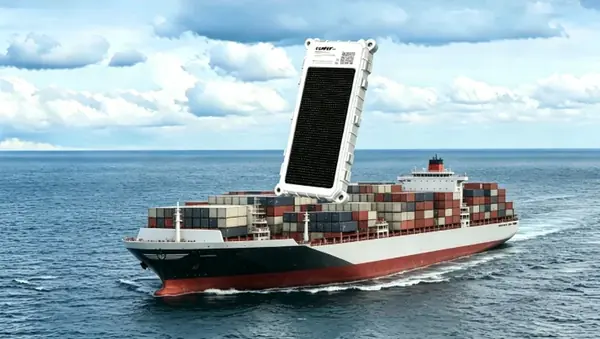
The “Digital Life” of Containers: From Passive Blind Boxes to Active Sensing
In the complex network of the global supply chain, a shipping container often goes through multiple transfers by road, rail, and sea. In the past, once a container left the port, it was like entering a “black box,” making it difficult to monitor its location, temperature, vibration, and other statuses in real time.
The introduction of self-powered technology has given containers a true “digital life.” Modern smart tracking terminals utilize built-in high-efficiency solar panels, combined with large-capacity lithium batteries, to achieve long-term standby even in low-light or no-light environments. These solar-powered GPS trackers can intelligently identify changes in transport modes. When a container is transferred from a truck to a ship, the built-in motion sensors will automatically adjust the data reporting frequency, maximizing power savings while ensuring safety visibility. This “self-sufficient” design not only eliminates the hassle of manual charging but also enables full-chain, 24/7 precise tracking and tamper-proof monitoring for cold chain logistics and the transport of high-value goods.
“Infinite Endurance” for Ocean Buoys: Capturing Every Pulse of the Deep Sea
For ocean observation buoys, the energy problem is crucial to their very survival. Buoys are usually deployed in deep waters dozens or even hundreds of nautical miles from the coast, responsible for collecting key data on meteorology, hydrology, and water quality.
The new generation of autonomous marine buoys has achieved true “self-sufficiency.” They no longer rely solely on solar power but adopt a complementary power generation mode of “wave energy + solar energy.” Wave energy capture devices generate electricity using the up-and-down motion of the ocean, ensuring continuous operation even on cloudy and rainy days. These buoys are not only equipped with various high-precision ocean sensors but also integrate 5G maritime base station functions, transmitting the massive amounts of collected data back to land in real time. This self-powered, high-bandwidth communication capability greatly improves the efficiency of marine research and provides strong support for maritime search and rescue.
The “Safety Shield” for Vessels: Smart Positioning and Emergency Communication
In the field of vessel safety, self-powered positioning and communication devices serve as the last line of defense. When a vessel encounters extreme weather or suffers a collision that causes the main power to fail, an independent self-powered system can ensure that critical information is sent out.
For example, positioning devices designed for all-sea-depth marine equipment or power buoys use an intelligent control logic combining photosensitive switches and tilt sensors. When the device senses that it is underwater or in an abnormal posture, it will automatically enter a low-power sleep mode. Once it surfaces, the system will immediately wake up and send a short message via satellite, transmitting precise geographic location information to the mother ship or control center. This mechanism of “sleeping normally, waking up in emergencies,” combined with the continuous energy replenishment from flexible solar panels, ensures the high reliability of the equipment in emergency situations, winning precious golden time for maritime rescue.
A Symphony of Green and Smart: The Future of Maritime IoT
From container logistics tracking to ocean buoy observation, and then to vessel safety assurance, self-powered tracking and communication technology is weaving a “blue IoT” that covers the globe. This network not only breaks free from the reliance on traditional fossil fuels and frequent manual maintenance but also achieves highly efficient equipment operation through intelligent energy management (such as automatically adjusting power consumption based on light and motion status).
In the future, with the improvement of photoelectric conversion efficiency and the development of ultra-low-power communication technologies, these maritime devices will become more miniaturized and intelligent. They will be like “glowing jellyfish” in the ocean, utilizing natural energy to silently guard the smooth flow of global trade and the health of the marine environment, ensuring certainty for every voyage.