
When the wheels leave the hustle and bustle of the city, or a tent is pitched by a tranquil lakeside, modern outdoor life is no longer a monk-like wilderness survival. Cold drinks in the RV fridge, ambient lights at night, and fully charged drones and cameras—devices that once relied on heavy generators or scarce campsite grid power—can now be easily powered by a thin “sun-chasing” system. The emergence of ultra-thin flexible solar modules is completely breaking the bulk and limitations of traditional outdoor power supply, giving RVs and tents true off-grid freedom anytime, anywhere.
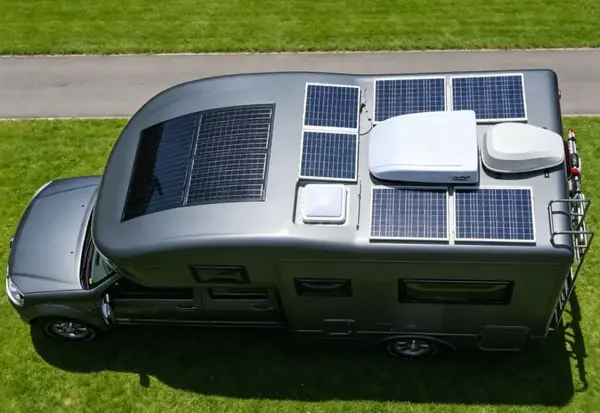
Ultimate Thinness and Conformability: Turning Every Curved Surface into a “Power Station”
Traditional rigid solar panels, while offering stable power generation efficiency, are often an “unbearable weight” for RV roofs due to their bulky size and rigid physical form. They are not only difficult to adapt to the complex curves of an RV roof, but also create massive wind resistance and noise at high speeds, and even pose safety risks of being blown away by strong winds.
Ultra-thin flexible modules perfectly solve this pain point. With a thickness of usually less than 3mm, their weight is only a fraction of traditional glass modules, feeling like a thin “power-generating wallpaper.” Thanks to their excellent flexibility, they can be applied like a film, perfectly and seamlessly conforming to the curves of an RV roof, RV awnings, or even the top of a tent. This “tailor-made” installation method not only maximizes the available power generation area but also maintains the streamlined aesthetics of the vehicle, truly achieving a unity of non-destructive installation and efficient power generation.
Bidding Farewell to “Range Anxiety”: An All-Weather Off-Grid Energy Butler
For RV travelers who love long-distance traversing, “battery anxiety” is the biggest nightmare. Once the power runs out, not only do household appliances stop working, but even starting the vehicle might be compromised.
Flexible modules, paired with highly efficient MPPT controllers and LiFePO4 (lithium iron phosphate) batteries, build a powerful off-grid energy butler system. During the day, whether the RV is speeding on the highway or resting at a campsite, the flexible modules on the roof are silently absorbing sunlight and continuously charging the battery. Even in low-light environments such as cloudy days, early mornings, or late evenings, advanced thin-film or perovskite technologies can maintain stable power output. This means that whether in the desolate Gobi desert or a snowed-in forest, you can comfortably enjoy the RV air conditioning, cook on an induction stove, and completely bid farewell to the embarrassment of searching for charging piles everywhere.
The “Foldable Power Station” in a Backpack: A Lightweight Revolution for Tent Camping
For hikers, backpackers, or lightweight camping enthusiasts, every gram of weight is crucial. Although traditional folding solar panels are portable, they still take up considerable space when packed.
Today, portable power sources based on new-generation flexible materials (such as roll-up perovskite photovoltaics) are sparking a lightweight revolution. These products are as thin as fabric and extremely lightweight, easily rolled up and stuffed into a backpack, or simply laid out on top of a tent or hung on a tree branch upon reaching the campsite. Some products even integrate USB-C/A dual output ports, requiring no complex controllers to directly charge mobile phones, tablets, or outdoor lighting equipment. This minimalist “lay it out and use it” design makes acquiring power in the wilderness more elegant and composed than ever before.
Rugged Outdoor DNA: A Reliable Companion Unfazed by Wind and Rain
The outdoor environment is highly variable; strong winds, heavy rain, hail, and UV rays are all severe tests for equipment. Excellent flexible modules for RVs and tents are meticulously crafted using high-polymer encapsulation materials, possessing extremely strong tear and impact resistance.
They not only feature an IP65 or higher waterproof rating to easily handle heavy rain, but also operate stably under extreme temperature differences from -40°C to 85°C. Furthermore, to address the high-frequency vibrations during vehicle travel and the local shading caused by trees, modern flexible modules adopt a special Matrix circuit design. Even if a portion of the module is shaded, the rest can continue to generate power, maximizing the reduction of power loss.
From heavy generators to thin flexible modules, the evolution of outdoor power supply is essentially the continuous extension of human boundaries in exploring nature. It frees us from the constraints of the power grid, giving every departure a solid foundation. In the future, with further improvements in photoelectric conversion efficiency and breakthroughs in materials science, we have every reason to believe that every tent and every RV will become a mobile green energy fortress, accompanying us to even more distant horizons.