
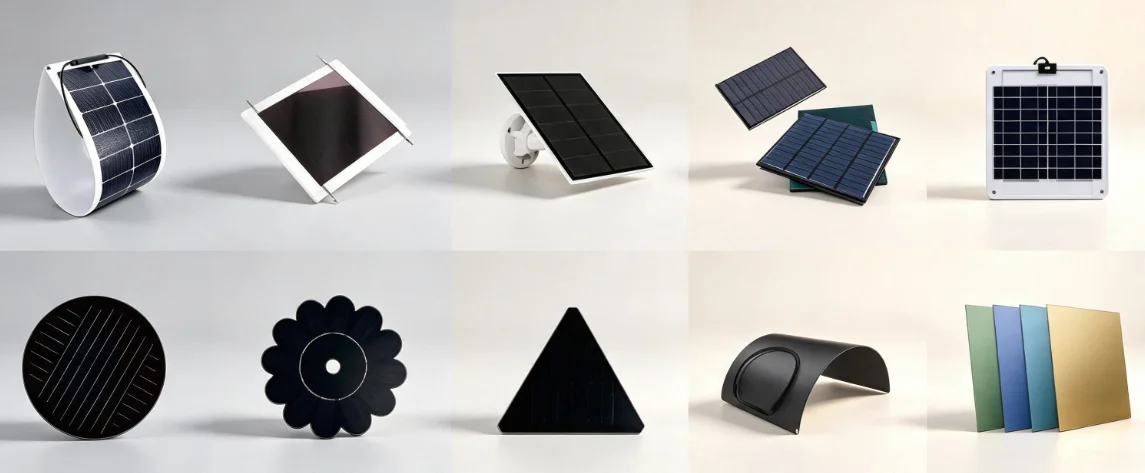
In scenarios like IoT power supply, off-grid equipment, and portable power stations, solar panels are the core component. However, when you browse procurement platforms, you will find various encapsulation methods—ETFE, PET, BC, epoxy resin, glass, etc.—with prices ranging from a few dollars to hundreds. What are the differences, and how should you choose?
As a source manufacturer with an 8,000㎡ production base, Shanghai Geningtech helps customers answer this question daily. Today, we will thoroughly explain the differences, pros and cons, and application scenarios of the five mainstream solar panel types. After reading this, you will be able to judge which one to choose. More importantly, regardless of the power, shape, or size of the solar panel you need, we can customize it for you, including high-end BC solar panels.
I. Quick Overview of Core Differences Among Five Solar Panel Types
| Encapsulation Type | Core Features | Power Range | Price | Application Scenarios |
|---|---|---|---|---|
| Epoxy Resin (Drip Glue) | Simple process, extremely low cost | 0.1W ~ 3W | Low | Low-current charging, teaching demos |
| PET Lamination | Flexible, bendable, high cost-performance | 0.3W ~ 30W | Medium-Low | Outdoor 3C products, sensor power supply |
| ETFE Lamination | Super high light transmittance, top-tier weather resistance | 0.5W ~ 100W | High | Industrial IoT, long-lifespan projects |
| Glass Lamination | Tempered glass encapsulation, high power | 10W ~ 180W+ | Medium | Fixed base stations, large power systems |
| BC Back Contact | No front grid lines, high aesthetic & efficiency | 1W ~ 60W | Highest | High appearance requirements, high-end equipment |
II. Epoxy Solar Panels (Epoxy Resin Encapsulation)
Directly encapsulating the circuit board with epoxy resin, the process is the simplest and the cost is the lowest.
Pros: Cheap, short production cycle.
Cons: Turns yellow and ages outdoors over time, light transmittance decreases year by year; low power upper limit (≤3W).
Applications: Toys, small electronic nameplates, power bank charging boards, teaching experiment kits.
III. PET Laminated Solar Panels
Using PET film as the backsheet and front sheet, laminated encapsulation, lightweight, flexible, and bendable.
Pros: Outstanding cost-performance—more durable than epoxy, cheaper than ETFE; good flexibility, can be attached to curved surfaces.
Cons: Ages under long-term UV exposure, outdoor lifespan 3~5 years.
Applications: Outdoor cameras, sensor data acquisition, portable charging bags, car ventilation.
IV. ETFE Laminated Solar Panels
ETFE (Ethylene Tetrafluoroethylene) is currently the best flexible encapsulation material, with aerospace-grade weather resistance.
Pros: Light transmittance 95%+ (high power generation efficiency); outdoor lifespan 8~10 years; resistant to UV, acid, alkali, and corrosion.
Cons: Higher cost (2~3 times that of PET).
Applications: Forest fire monitoring, hydrological telemetry, communication base stations, and other harsh environment projects at sea.
V. Glass Laminated Solar Panels
Tempered glass + EVA backsheet structure, same as traditional PV panels, with a high power upper limit.
Pros: Resistant to hail/heavy pressure; high power (up to 180W+); longest lifespan (15~20 years).
Cons: Heavy, non-bendable, high transportation cost.
Applications: Fixed IoT base stations, off-grid power stations, large monitoring system power supplies.
VI. BC Back Contact Solar Panels
Back Contact—moving all front grid lines to the back, pure black appearance, maximum aesthetic appeal.
Pros: No front obstruction → larger effective power generation area; minimalist and beautiful appearance; excellent low-light response.
Cons: Complex process, highest cost.
Applications: High-end consumer electronics accessories, building integration, OEM customer customization.
VII. Summary: How to Choose?
| Your Core Requirement | Recommended Solution |
|---|---|
| Limited budget, low power | Epoxy Resin (Drip Glue) |
| Cost-performance, flexible installation | PET Lamination |
| Harsh environment, long lifespan | ETFE Lamination |
| High power, fixed installation | Glass Lamination |
| Pursuing ultimate appearance, high-end positioning | BC Back Contact |
In actual projects, many customers use a combination: glass components for main power supply at communication base stations, and ETFE for backup lighting. There is no absolute “best” choice, only the one that best matches your scenario.
VIII. Shanghai Geningtech — Your Exclusive Custom Factory
As a source custom factory, Shanghai Geningtech supports the customization of the full series of ETFE, PET, BC, epoxy, and glass solar components, with a power range covering 0.1W~180W+.
Our Core Customization Capabilities:
- Various Powers: From micro-power 0.1W to high power 180W+, precisely matching your load requirements.
- Various Shapes: Circular, irregular, foldable, arc-shaped… as long as you can draw the blueprint, we can produce it.
- Various Sizes: Ultra-thin flexible, mini-micro, large-area arrays, dimensions fully customized to your needs.
- BC Solar Panels: High-end BC technology is also fully customizable. We offer customized 10wp BC components, 20wp BC components, 30wp BC components, and more, allowing your products to combine high performance with high aesthetic appeal.
From sample prototyping to mass delivery, we respond quickly to non-standard requirements. If you are struggling with project selection or need a unique solar component, please contact Shanghai Geningtech, and let us customize the optimal solution for you.