
When night falls, or when heavy rain and thick fog roll in, traditional traffic markings that rely solely on vehicle headlights often “disappear,” turning familiar roads into treacherous paths. Today, a type of “glowing neuron” known as solar road studs is lighting up highways, crosswalks, and tunnels with active illumination. They not only completely break free from the constraints of grid electricity but also elevate traffic safety warning lighting to an unprecedented level of intelligence through the integration of IoT and AI technologies.
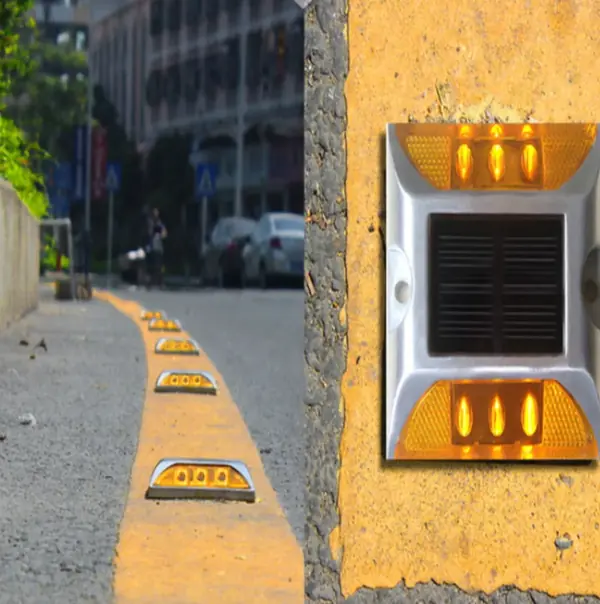
A Visual Revolution: From “Passive Reflection” to “Active Warning”
Traditional reflective road studs rely entirely on the illumination of vehicle headlights to reflect light. Once heavy rain, dense fog, or blizzards occur, the light is refracted by water vapor, drastically reducing the driver’s visibility and easily causing rear-end collisions or lane departures.
Active solar road studs completely overturn this limitation. Built with high-brightness LED wafer beads, they absorb light energy through micro solar panels on top and store it in internal batteries. As night falls or light dims, photosensitive sensors automatically wake up the studs, emitting highly penetrating active light. Whether in steady illumination or high-frequency flashing, this active lighting mode can easily pierce through rain and fog, clearly outlining the road contours, lane boundaries, and danger zones from hundreds of meters away. For drivers, it is like having a “starlight path” laid out ahead, greatly alleviating visual fatigue during night driving and making dangerous road sections crystal clear.
Scenario Empowerment: The “Safety Guardian” Everywhere
The application of solar road studs goes far beyond simple highway edges; it has permeated every capillary of urban traffic and expressways.
Highways and Sharp Curves: At highway interchange hubs, on/off ramp gore areas, or long downhill sections, smart studs can dynamically guide vehicle trajectories through synchronized flashing modes. In advanced AI traffic warning devices, tilt sensors are even built-in. When a vehicle collision or abnormal road vibration occurs, the studs can sense it within milliseconds and link with studs hundreds of meters behind to form a “light warning line,” alerting approaching vehicles in advance and effectively preventing secondary accidents.
Smart Crosswalks: In busy city intersections without traffic lights, laying down glowing “blue stars” or high-brightness studs can instantly capture drivers’ attention. When pedestrians step onto the crosswalk, the studs flash at high frequency, acting like a glowing safety corridor. This not only reminds vehicles to slow down and yield but also provides clear path guidance for pedestrians looking at their phones or those with poor visibility.
Tunnel Entrances and Exits: The stark contrast in light between the inside and outside of a tunnel can easily cause “black hole” or “white hole” effects. Densely installing oil-resistant and high-crush-resistant solar road studs at tunnel entrances and exits can smooth the light transition, clearly mark the tunnel edges, and effectively alleviate drivers’ visual blind spots.
Breaking Free from Wiring: The “Off-Grid” Survival Rule
For many remote mountainous areas, cross-sea bridges, or newly built roads, laying traditional grid-powered lighting systems faces pain points such as high costs for road excavation and wiring, as well as difficult future maintenance.
Solar traffic delineators provide a perfect “off-grid” solution. They adopt a highly integrated independent design, automatically charging during the day via high-efficiency monocrystalline silicon solar panels and working automatically at night. Thanks to ultra-low power consumption circuit design and high-capacity lithium batteries, they can guarantee continuous illumination for several days or even over a week during continuous rainy weather. This “plug-and-play” feature makes the installation process extremely simple, requiring no destruction of the existing road surface structure, greatly reducing construction difficulty and overall costs.
Smart Interconnection: From Single-Point Illumination to Full-Domain Synergy
With the development of IoT technology, modern solar road studs are no longer isolated light emitters. Through built-in wireless communication protocols like LoRa, the studs can form an invisible local area network.
In winding mountain roads or dense forests where sunlight is insufficient, active road stud systems can centralize the solar panels, batteries, and control circuits into a single control box, leaving only the LED display on the stud itself. This greatly enhances crush resistance (up to over 16 tons), adapting to the repeated rolling of heavy vehicles. In scenarios requiring linked warnings, once a single stud senses an anomaly, it can instantly transmit the signal to surrounding studs, achieving full-domain synchronized flashing. This evolution from “single-point passive” to “full-domain active synergy” turns every single stud into an acute nerve ending in the smart traffic network, jointly guarding the safety of every journey.