
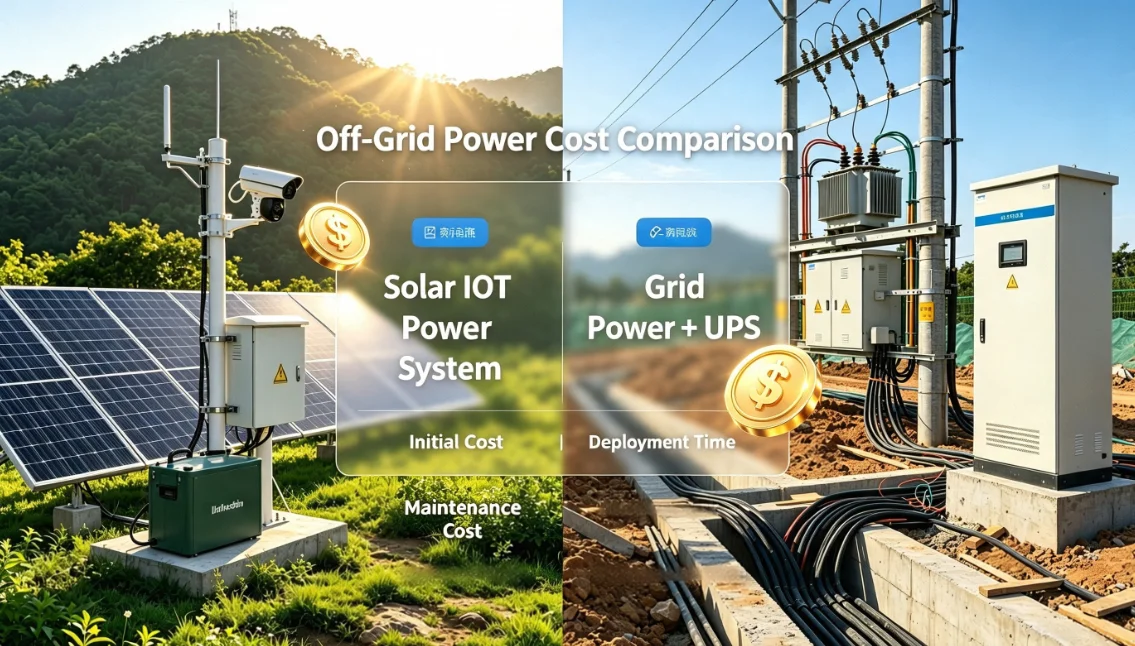
In the deployment of Internet of Things (IoT) devices, the choice of power supply directly impacts both the total project cost and long-term operational expenses. When it comes to off-grid environments, is it more cost-effective to rely on the traditional municipal grid paired with an Uninterruptible Power Supply (UPS), or to adopt the emerging solar-powered IoT supply systems? Let us crunch the numbers using real-world data to find out.
Typical Scenario Setup
Consider a forest fire monitoring station in a remote area as a representative example. The equipment consumes approximately 30W and requires 24/7 uninterrupted operation. We will compare the 5-Year Total Cost of Ownership (TCO) for both solutions. This scenario is highly representative, as tens of thousands of similar monitoring stations across the country require reliable power.
Traditional Solution: Municipal Grid + UPS
Grid Connection Costs: Running a power line from 3 to 5 kilometers away, including utility poles, cables, and labor, typically costs between $2,800 and $7,000. In many remote areas, the actual distance is longer, pushing costs up to $11,000–$14,000.
UPS Equipment: A UPS unit with batteries costs roughly $280–$560. Lead-acid batteries require replacement every 2 to 3 years, meaning at least one replacement is needed within a 5-year cycle.
Annual Electricity Costs: 30W × 24h × 365 days = 262.8 kWh. At an average rate of $0.08/kWh, this amounts to about $21 per year.
Maintenance Costs: Routine line inspections and maintenance run approximately $70–$140 annually.
Solar Solution: IoT Power Supply System
Equipment Costs: A complete setup featuring a 100W solar panel (ETFE encapsulation), a 30Ah LiFePO4 battery, an MPPT controller, and an IoT management module costs around $350–$500. Thanks to a cycle life of over 2,000 times, the LiFePO4 battery requires no replacement within 5 years.
Installation Costs: Pole mounting and securing cost roughly $70–$140.
Annual Maintenance: Primarily remote monitoring and inspection, costing about $28/year (including SIM card data fees). The IoT module reports real-time battery voltage, power generation, and device status, with automatic alerts for anomalies.
5-Year TCO Comparison: The Financial Reality
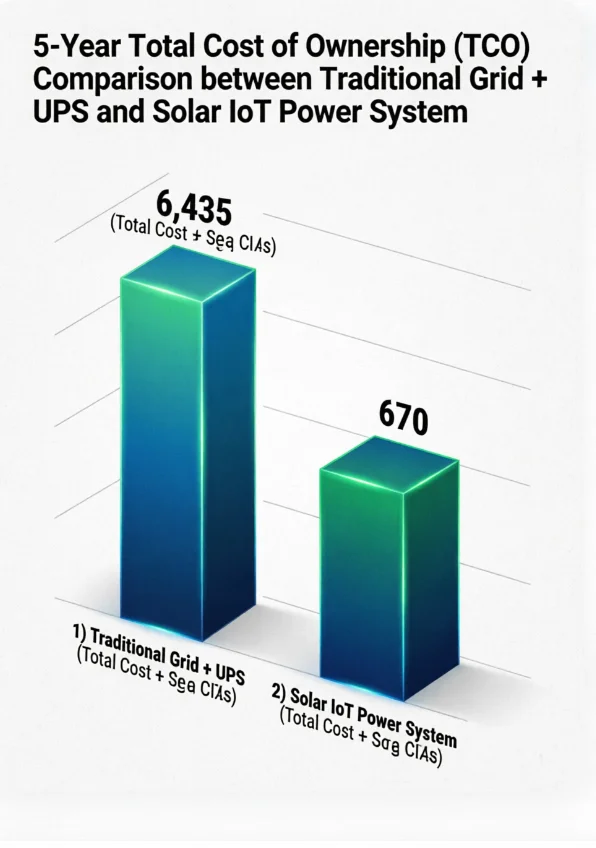
The following table and chart illustrate the massive financial divergence between the two approaches over a standard 5-year project lifecycle:
| Cost Category | Traditional Grid + UPS | Solar IoT Power System | Savings / Advantage |
|---|---|---|---|
| Initial Setup (Grid/Install) | ~$5,000 (Trenching & Cables) | ~$110 (Pole Mounting) | Save ~$4,890 upfront |
| Equipment Cost | ~$420 (UPS Unit) | ~$420 (Solar + LiFePO4 + IoT) | Comparable |
| Battery Replacement (5 Yrs) | ~$420 (Lead-acid replacement) | $0 (2000+ cycle LiFePO4) | Zero maintenance cost |
| Annual Electricity | ~$21 / year | $0 (100% Green Energy) | Zero running cost |
| Annual Maintenance | ~$70 – $140 (Line inspection) | ~$28 (Remote IoT monitoring) | Save ~80% on OPEX |
| Deployment Time | 2 to 3 Months | 1 Day | Massive time efficiency |
| 5-Year Total Cost (TCO) | ~$6,435 | ~$670 | Total Savings: ~$5,765 |
Beyond the Balance Sheet: Strategic Advantages
Cost is not the only factor. The operational and environmental benefits of solar IoT systems provide additional strategic value:
| Metric | Traditional Grid | Solar IoT System | Improvement |
|---|---|---|---|
| Carbon Emissions | High (Grid dependent) | Zero (100% Renewable) | 🌿 Eco-Friendly |
| Grid Dependency | 100% Reliant | 0% Off-Grid | 🔋 Energy Independent |
| Data Visibility | Blind (Manual checks) | Real-time IoT Dashboard | 📊 Smart Management |
| ESG Compliance | Low | High (Green Subsidies) | 🏆 Policy Aligned |
Conclusion: The Clear Winner for Off-Grid Deployment
The solar IoT power solution saves nearly $5,700 over 5 years! On average, it saves about $1,140 annually. Furthermore, it eliminates the need to apply for municipal grid access, reducing deployment time from 2–3 months to just a single day.
Especially in remote areas without grid coverage, solar-powered IoT systems are the only viable option. Additionally, these systems produce zero carbon emissions, aligning perfectly with ESG and carbon neutrality policies, and may even qualify for green subsidies in certain regions.
Shanghai Geningtech provides integrated, split, and portable solar IoT power systems equipped with remote IoT monitoring modules. Track battery levels and power generation in real-time, and receive instant alerts for any anomalies. Contact us today for customized solutions.