
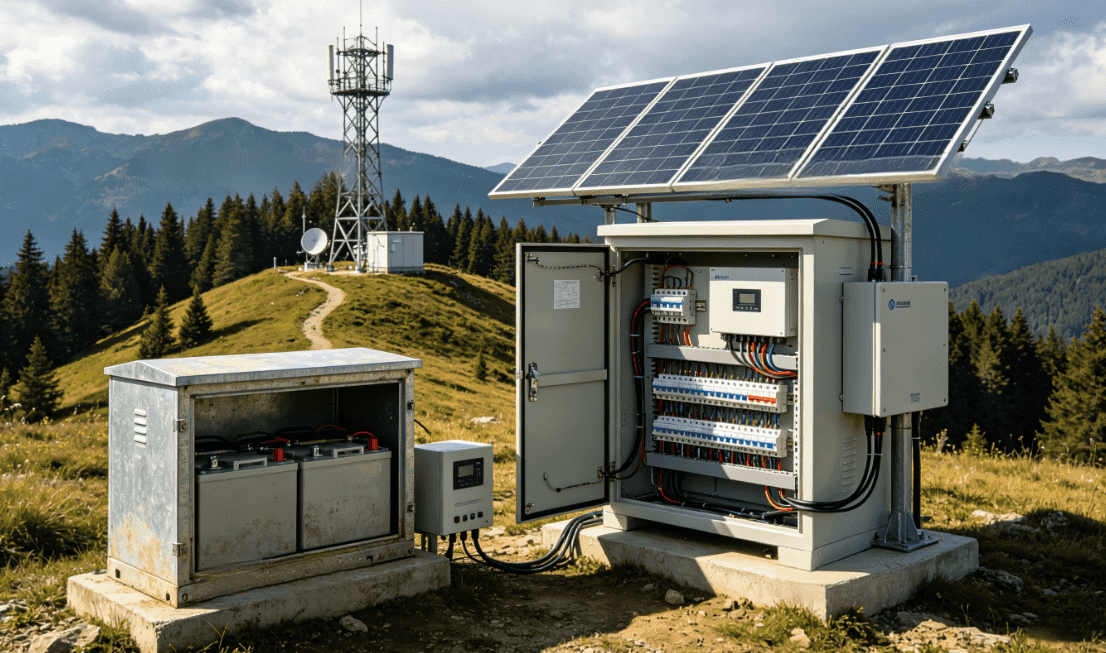
1. Introduction: The Power Crisis Facing Remote Telecom Infrastructure
Globally, mobile communication operators operate millions of telecom base stations, delivering seamless connectivity covering metropolitan zones and remote mountainous regions. Industry statistics indicate over 30% of these sites are located in off-grid or weak-grid rural areas. Stable power supply at these remote towers directly determines network quality for hundreds of millions of mobile and IoT end-users.
Major telecom operators and tower management companies continuously allocate massive budgets to guarantee reliable power for distributed communication sites. For more than a decade, remote base stations have relied on the classic combination of lead-acid batteries and diesel generators as backup power. However, the large-scale rollout of 5G networks and explosive growth of edge IoT devices have dramatically increased site power consumption. A single 5G base station consumes 2.5~4 times more power than equivalent 4G equipment. Legacy power infrastructure is facing mounting pressure for comprehensive upgrades.
Without optimized renewable energy power solutions, remote telecom towers will suffer from frequent downtime, soaring operational expenses and unstable network availability. Solar hybrid power systems built on LiFePO4 batteries and high-efficiency MPPT solar controllers have become the most viable upgrade solution for telecom infrastructure owners.
2. Pain Points of Traditional Lead-Acid + Diesel Generator Power Solutions
Conventional power setups combining valve-regulated lead-acid (VRLA) batteries and diesel generators carry inherent drawbacks that drive long-term high operating costs and reliability risks.
2.1 Critical Limitations of Lead-Acid Batteries
| Comparison Item | Traditional Lead-Acid Battery |
|---|---|
| Cycle Lifespan | Only 2~3 years under frequent charge-discharge telecom operating conditions. Lifespan can drop to several months after deep discharge caused by generator failure |
| Low-Temperature Performance | Capacity decreases by 40~60% below -10°C. Operators have to deploy extra battery banks for winter compensation, raising capital costs |
| Maintenance Demand | Mandatory regular on-site inspections, electrolyte maintenance and density testing. Annual maintenance cost per site reaches $70~$145 in labor expenses |
| Self-Discharge Rate | 10~15% per month, leading to energy loss during long idle periods |
2.2 Drawbacks of Diesel Generator Deployment
- Continuous fuel expenditure represents the largest portion of remote site operational costs. Monthly diesel costs for isolated telecom towers range from $280 ~ $720.
- Sites require periodic on-site refueling and inspection. Fuel transportation becomes high-risk work under extreme weather.
- Fuel theft creates persistent financial losses for telecom operators in many regions, causing billions in cumulative losses annually.
- Diesel exhaust emissions conflict with global carbon neutrality and net-zero carbon targets for communication infrastructure.
3. Step-by-Step Upgrade Roadmap: Transition to LiFePO4 Battery + MPPT Solar System
Retrofitting remote telecom towers with solar hybrid power follows a standardized three-stage upgrade process to achieve stable, low-carbon power supply.
Step 1: Replace Lead-Acid Battery Banks with LiFePO4 Energy Storage
Lithium Iron Phosphate (LiFePO4 / LFP) batteries serve as the core energy storage component of the upgraded solar system, bringing fundamental improvements over lead-acid alternatives.
- Cycle life exceeds 2,000 cycles, supporting 5~7 years of service with one daily charge-discharge cycle
- Weight is only 1/3 of equivalent-capacity lead-acid batteries, drastically cutting installation labor costs
- Monthly self-discharge rate drops to 3%, far superior to lead-acid storage
- Wide operating temperature range of -20°C ~ 60°C, eliminating the requirement for constant-temperature air conditioning in equipment cabinets
- Built-in BMS (Battery Management System) monitors cell voltage and temperature in real time, offering automatic cell balancing and multi-layer safety protection
Step 2: Upgrade PWM Solar Controllers to High-Efficiency MPPT Controllers
Maximum Power Point Tracking (MPPT) technology improves solar charging efficiency by 25~35% compared with outdated PWM controllers.
- Effective power capture persists under cloudy weather and low-light diffuse sunlight
- Multi-channel MPPT design allows connection of solar panels installed on different orientations (east-facing panels for morning power, west-facing panels for afternoon generation) to maximize daily energy yield
- Supports seamless integration with telecom FSU monitoring systems, automatic diesel generator trigger control and multi-level overvoltage/overcurrent protection
Step 3: Deploy IoT Remote Monitoring Module
Smart IoT modules enable full remote visibility of on-site power metrics at the tower operation control center: battery SOC, real-time solar generation, load power consumption and ambient temperature. Operators can remotely switch equipment and adjust operational parameters. The module reduces physical site visits by over 90% and supports standard FSU communication protocols for unified network management.
4. TCO & Investment Return Analysis: Before vs After Retrofit
We analyze a typical remote off-grid telecom base station to quantify cost differences before and after solar retrofit.
Base Case Cost Comparison
| Cost Item | Legacy Lead-Acid + Diesel Solution | Solar Hybrid LiFePO4 + MPPT Retrofit Solution |
|---|---|---|
| Core Equipment Capital Investment | 48V 200Ah Lead-acid battery pack: ~$1,140; service life 2.5 years, annualized cost ~$460 | 48V 600Ah LiFePO4 battery ~$2,570; MPPT controller ~$285~$430; 1000W solar panel ~$430~$570; IoT monitoring module ~$145; total initial investment ~$3,430 |
| Annual Fuel Expense | $2,850 ~ $4,280 (higher for extremely remote locations) | Diesel generator works only as emergency backup; annual fuel cost drops to $430 ~ $720 |
| Annual O&M Labor Cost | $710 ~ $1,430 | $285 ~ $430 |
| Annualized Battery Replacement Cost | ~$460 | ~$285 (8-year service cycle) |
| Estimated Annual Operating Expense | $4,020 ~ $6,170 | $999 ~ $1,435 |
The retrofit delivers annual operational savings of $2,570 ~ $4,000. For most remote telecom towers, the payback period averages 12~14 months.
Pilot projects operated by tower management companies verified that solar hybrid upgrades boost base station uptime from 97% to 99.8%, while user network fault complaints drop by over 60%.
5. Shanghai Geningtech’s All-in-One Telecom Base Station Solar Retrofit Advantages
Shanghai Geningtech delivers end-to-end solar power retrofit solutions for communication base stations, with core hardware independently researched and manufactured under the SQTENERGY brand.
High-Reliability MPPT Solar Controllers
Conversion efficiency >98%, supports multi-channel PV input, 5-year factory warranty, built-in generator auto-start logic customized for telecom tower scenarios.
Smart LiFePO4 Battery Packs with Integrated BMS
Supports RS485 / CAN communication, compatible with mainstream tower FSU monitoring platforms, wall-mounted compact design (thickness only 15cm) to fit limited cabinet space.
Heavy-Duty Solar Panels
ETFE flexible solar modules and tempered glass solar panels available; wind resistance up to 200km/h, anti-salt spray corrosion, 10-year performance warranty.
Cloud IoT Management Platform
Natively supports standard FSU protocols, real-time data reporting, intelligent alarm triggering and work order dispatch for tower operators.
We provide full turnkey services including site survey, customized system design, equipment supply and on-site installation guidance. To date, Geningtech has completed solar power upgrades for over 200 communication base stations with stable long-term field operation results.
6. Frequently Asked Questions About Telecom Tower Solar Retrofit
Q1: Will the retrofit process interrupt normal base station power supply?
Our solution supports zero-power-interruption reconstruction. The solar system and LiFePO4 battery pack run in parallel with the original power setup first. After stable performance verification, the legacy lead-acid batteries can be decommissioned without network downtime.
Q2: How should operators handle existing diesel generators after solar installation?
We recommend retaining diesel generators as emergency backup power. Daily site load is supplied by solar PV and LiFePO4 batteries. Generators only activate during extended continuous overcast weather beyond the designed battery autonomy (typically 7 days).
Q3: Where can equipment be installed when the telecom cabinet has limited space?
Our LiFePO4 batteries adopt slim wall-mounted housings with only 15cm thickness for cabinet wall installation. Solar panels can be fixed on tower poles or rooftop frameworks.
Q4: How does solar system performance hold up in haze-prone regions?
MPPT controllers can still harvest power under diffuse light. Solar output under heavy haze reaches 20~40% of peak sunny power. We calculate extra solar panel capacity into system design to offset low-irradiation weather conditions.
7. Standard System Configuration Packages for Different Telecom Base Station Types
| Base Station Type | Typical Load Power | Recommended System Configuration | Reference Total Budget | Estimated Annual OPEX Savings | Average Payback Period |
|---|---|---|---|---|---|
| Small Micro Base Station / Repeater (200~500W load, unstable weak grid access) | 200–500W | 600W Solar Panel + 48V 100Ah LiFePO4 Battery + MPPT Controller + IoT Module | ~$1,710 | ~$1,430 | 12–16 months |
| Standard Macro Base Station (1000~2500W load, minimum 3-hour backup demand) | 1000–2500W | 2000W Solar Panel + 48V 300Ah LiFePO4 Battery + MPPT Controller + IoT Module | ~$5,000 | ~$4,280~$7,140 | 12–18 months |
| Large Aggregation / Core Node Station (3000~5000W load, long-duration backup requirement) | 3000–5000W | 4000W Solar Panel + 48V 600Ah LiFePO4 Battery + MPPT Controller + IoT Module | ~$8,570 | ~$8,570~$11,430 | 12–18 months |
All packages include industrial-grade MPPT solar controllers and remote IoT monitoring modules with native FSU protocol compatibility for tower operator unified management platforms.
8. Conclusion
Against the backdrop of expanding 5G and global net-zero carbon targets, remote telecom tower power upgrades are no longer optional. The transition from lead-acid batteries and diesel generators to solar hybrid LiFePO4 + MPPT power systems reduces long-term operational expenditure, improves network uptime and cuts carbon emissions simultaneously.
For tower operators and communication infrastructure investors, evaluating total lifecycle cost instead of only upfront CAPEX is critical. Remote sites more than 500 meters away from public grid lines deliver the fastest ROI for solar retrofit projects. Shanghai Geningtech provides customized, scalable solar power solutions to help telecom stakeholders optimize distributed base station energy infrastructure.
If you require site-specific load calculation, customized system design or datasheets for MPPT controllers and LiFePO4 batteries, contact our engineering team for technical support.